


Most homeowners in Wollongong don’t think twice about their home’s earthing system. It’s hidden inside the walls, it doesn’t make noise, and it doesn’t show up on your power bill. But when it starts to fail, the consequences can range from annoying to genuinely dangerous.
Faulty earthing is one of the leading causes of electrical fires and electrocution in residential properties across Australia. The trouble is, the warning signs are easy to dismiss or blame on something else. A flickering light gets blamed on a cheap bulb. A mild tingle from a tap gets shrugged off. That burning smell? Must have been the toaster.
If you know what to look for, you can catch these problems early before they turn into something serious.
Key Takeaways
- Earthing protects you by giving fault current a safe path to the ground, away from your body
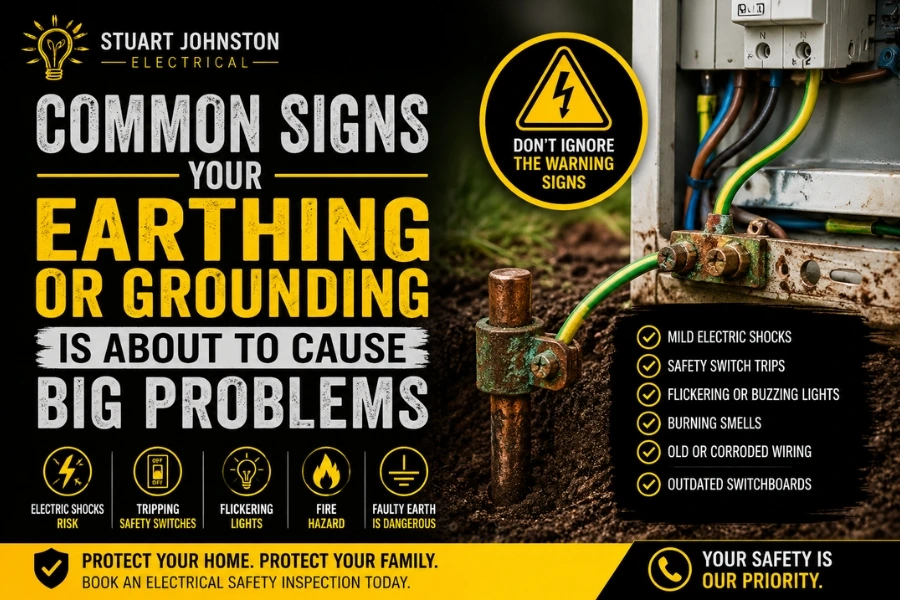
- Warning signs include mild electric shocks, constantly tripping safety switches, and flickering lights
- Coastal areas like Wollongong face higher risk of earthing degradation due to salt air and moisture
- Older homes built before the 1990s may never have had a proper earthing system installed
- Faulty earthing is not a DIY fix. It must be inspected and repaired by a licensed electrician
- Ignoring early signs can lead to electrical fires, appliance damage, or electrocution
- A wiring inspection report can identify problems before they become emergencies
What Is Earthing and Why Does It Matter?
In simple terms, earthing (also called grounding) connects your home’s electrical system to the earth itself, usually via a copper rod driven into the ground near your meter box. This connection gives stray electrical current somewhere safe to go if something goes wrong inside your wiring or appliances.
Without it, that fault current has nowhere to go except through whatever happens to be touching the circuit next. Which could be you.
In Australia, earthing requirements are governed by the AS/NZS 3000 Wiring Rules, and all new installations must meet these standards. However, many older homes in the Illawarra region were built at a time when earthing requirements were far less strict, or the earthing that was installed has simply degraded over decades.
Understanding Australian wire colour codes can help you identify the earth wire (green and yellow striped) if you ever need to describe what you’ve seen to an electrician.
Warning Signs Your Earthing System Is Failing
1. You Keep Getting Mild Electric Shocks
This is the one most people brush off. You touch a tap, grab a metal appliance, or put your hand on a light switch and feel a faint tingle. It feels minor. It probably happens once and you forget about it.
That tingle is fault current passing through your body instead of through a proper earth path. It means stray voltage is present somewhere in your home that shouldn’t be there.
Don’t wait for the shock to get stronger. A mild tingle today can be a serious shock tomorrow, especially if your earthing continues to deteriorate.
2. Your Safety Switches Keep Tripping
Safety switches (RCDs) are designed to detect current imbalances caused by earth faults. When yours is tripping regularly without an obvious cause, it’s doing exactly what it’s supposed to do: it’s detecting a problem.
The issue is when homeowners treat a tripping safety switch as an inconvenience rather than a warning. They reset it, the power comes back, and the problem is forgotten until it trips again.
This is one of the clearest signs that something in your earthing or wiring needs attention. You can read more about how safety switches work and why they’re critical for your home to understand what that tripping is actually telling you.
3. Flickering or Buzzing Lights
Lights that flicker unpredictably, or fittings that make a buzzing sound, are sometimes caused by voltage fluctuations tied to a faulty earth. If the issue is limited to one fitting, it might just be a loose connection. But if it’s happening throughout the house or across multiple circuits, earthing needs to be on your suspect list.
A related issue is circuit breakers that trip repeatedly without a clear overload reason. If this is something you’re dealing with, it’s worth reading about what happens when a circuit breaker keeps tripping as the causes often overlap with earthing faults.
4. Burning Smell or Scorch Marks Near Outlets
A burning smell near a power point, or scorch marks around the outlet cover, should never be ignored. This can indicate arcing, which happens when current is jumping across a gap it shouldn’t be crossing. Faulty earthing contributes to this by allowing fault current to take unintended paths through your wiring.
Scorch marks are a sign that something has already gotten hot enough to cause damage. At that point, the risk of an electrical fire is real and immediate.
5. Appliances Running Strangely
If appliances seem to run hotter than usual, behave erratically, or fail prematurely, earthing problems can sometimes be the cause. Poor earthing can expose your appliances to voltage spikes and electromagnetic interference that they weren’t designed to handle.
This is especially common with sensitive electronics like computers, televisions, and home entertainment systems. If you’re replacing the same appliances repeatedly and can’t figure out why, it’s worth having your electrical system inspected.
6. Your Switchboard Is Old or Has No Safety Switches
Homes in Wollongong and the Illawarra that were built before the mid-1990s often have switchboards that don’t include modern safety switches or proper earthing arrangements. Some older ceramic fuse boards were never earthed to current standards at all.
If your switchboard still uses ceramic fuses, or you’re not sure whether safety switches are installed, these are serious gaps in your home’s protection. A switchboard upgrade can address earthing deficiencies at the same time as bringing your switchboard up to current safety standards.
7. Corrosion on Electrical Components
In coastal areas like Wollongong, Shellharbour, and Kiama, salt air accelerates corrosion on metal components including earthing conductors and connections. A corroded earth connection has higher resistance, which means it’s less effective at carrying fault current safely away from your home.
This is a particular risk for older properties close to the ocean, and it’s not always visible without a proper inspection.
Why Earthing Fails in Wollongong Homes
Several factors increase the likelihood of earthing problems specifically in the Illawarra region:
Age of the property. Many homes in suburbs like Fairy Meadow, Corrimal, and Dapto were built in the 1960s and 70s under old standards. Earthing systems from that era may not meet current requirements and may have degraded significantly.
Coastal conditions. Salt air and moisture from the ocean accelerate the corrosion of copper earthing conductors, especially at connection points. Properties within a few kilometres of the coast face this risk more than inland suburbs.
Renovations done without permits. Unlicensed electrical work during a renovation can disturb or disconnect existing earthing without the owner knowing. This is one reason all electrical work in Australia legally requires a licensed electrician.
Soil conditions. The effectiveness of an earth stake depends partly on soil moisture. In drier periods, the resistance of the earth can increase, reducing the effectiveness of the earthing system.
What is earthing in a house?
Earthing connects your home’s electrical system to the ground via a copper conductor and earth stake. This gives fault current a low-resistance path to earth, preventing it from passing through people or causing fires. In Australia, earthing is required under AS/NZS 3000 and must be installed and tested by a licensed electrician.
What to Do If You Suspect Earthing Problems
Do not attempt to inspect or repair earthing yourself. Under NSW law, earthing is classified as electrical wiring work and must only be carried out by a licensed electrician. Even turning off the main switch does not make it safe for an untrained person to work on.
If you’re noticing any of the warning signs above, the right step is to contact a licensed Wollongong electrician for an inspection. A proper electrical safety inspection will assess your earthing conductors, connections, earth stake, and switchboard to identify exactly where the problem lies.
If the problem is urgent, such as regular electric shocks or burning smells, treat it as an emergency and have it looked at the same day. You can reach Stuart Johnston Electrical for prompt inspections across Wollongong and the surrounding Illawarra area.
Conclusion
Your home’s earthing system works silently in the background every day. Most of the time, you’ll never know it’s there. But when it starts to fail, it rarely announces itself loudly. The signs are usually small and easy to dismiss until they’re not.
If anything in this article sounded familiar, whether it’s the occasional tingle, a safety switch that trips without warning, or an old switchboard with no memory of when it was last looked at, now is the right time to have it checked. Getting a qualified Wollongong electrician to inspect your earthing is a straightforward job that can prevent outcomes that aren’t.
FAQ
Common signs include mild electric shocks from taps or appliances, safety switches that trip repeatedly, flickering lights, and burning smells near power points. A licensed electrician can confirm a faulty earth with testing equipment.
Yes. Faulty earthing is a direct risk factor for electrocution and electrical fires. It allows fault current to travel through unintended paths, including through people.
No. Earth testing requires calibrated equipment and must be performed by a licensed electrician. There is no safe DIY method for testing or repairing earthing.
A well-installed earthing system can last the life of the property, but connections, conductors, and earth stakes can degrade over time, particularly in coastal environments. Regular inspections help catch deterioration early.
No. Older homes, particularly those built before the 1980s, may have incomplete or non-compliant earthing. If your home has never had a full electrical inspection, it is worth getting one.
Earthing provides the physical path for fault current to flow safely to the ground. A safety switch (RCD) monitors current flow and disconnects power when it detects a fault. Both work together to protect you, but they are not the same thing.
A switchboard upgrade can address some earthing deficiencies, particularly the installation of safety switches and modern protective devices. However, the earth conductor and stake also need to be inspected separately.
Costs vary depending on the size and age of the property. For an accurate quote specific to your home in the Wollongong area, contact a licensed local electrician directly.
Call a licensed local electrician who services the Illawarra region. Stuart Johnston Electrical covers Wollongong and surrounding suburbs including Shellharbour, Dapto, Kiama, and Albion Park.