


We get called out to a lot of homes across Wollongong and the Illawarra, and it’s surprising how often the same problem shows up: a power board doing a job it was never built for.
Power boards are genuinely useful. They let you plug in extra devices without ripping open a wall to add new power points. But they can also become a hidden fire risk if they’re overloaded, damaged, or covered up and forgotten under a desk.
Here are the five mistakes we see most often and what to do instead.
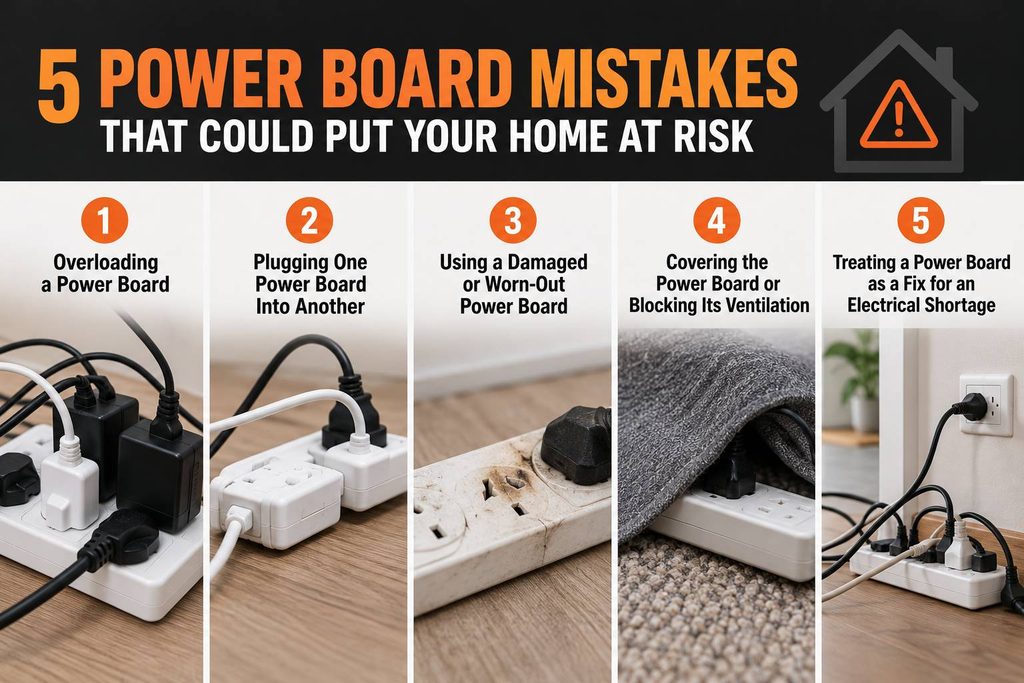
1. Overloading a Power Board
It’s easy to assume that a board with six or eight sockets gives you six or eight times the power. It doesn’t. A power board only adds places to plug things in, it doesn’t add extra electrical capacity to the circuit behind it.
Some everyday appliances draw a lot more power than people expect:
| Appliance | Why It Needs Extra Care |
| Portable heaters | Very high power demand |
| Kettles | High short-term load |
| Microwaves | High power demand |
| Toasters | High heating load |
| Air conditioners | Significant, sustained load |
Running two or three of these from the same board at once is one of the fastest ways to overload a circuit. If you’re constantly juggling plugs, that’s a sign you need more power points – not more boards.
2. Plugging One Power Board Into Another
This one has a name: piggybacking. It’s tempting when you’re short on sockets, but stacking boards on top of each other increases the load on a single outlet and adds another weak link that can fail.
If you find yourself doing this regularly, it’s worth having an electrician install extra power points where you actually need them, rather than relying on a chain of boards and extension leads.
3. Using a Damaged or Worn-Out Power Board
A power board can look fine on the outside while the cord, plug, or internal switches have quietly worn out. Before you plug one in, give it a quick check for:
- Frayed or exposed wiring
- Cracked plastic housing
- Burn marks or discolouration
- Loose or sticky switches
- Bent or damaged plug pins
- Unusual heat, buzzing, or a burning smell
If anything looks or feels off, stop using it. A new power board costs a few dollars – an electrical fault can cost a lot more. It’s also worth checking whether an older model has ever been recalled.
4. Covering the Power Board or Blocking Its Ventilation
Power boards generate heat while they’re running, so they need a bit of breathing room. It’s incredibly common for one to end up buried under a rug, bedding, clothing, or wedged behind a desk – out of sight and out of mind.
Keep boards in an open, dry spot, and make sure every plug is pushed in firmly. A loose connection can arc and generate heat even when the board itself is fine.
5. Treating a Power Board as a Fix for an Electrical Shortage
If your home never seems to have enough power points, adding another board might feel like the answer – but it’s really just a workaround. If you’re relying on several boards around the house, that’s usually a sign the underlying electrical setup needs attention.
An electrician can tell you whether you need more points, a circuit upgrade, or other work – and whether your current setup meets today’s standards.
It’s also worth knowing the difference between two safety devices people often confuse:
- Circuit breaker: Protects against excessive current.
- Safety switch: Protects people from electric shock caused by certain electrical faults.
Neither one is the same thing as a power board or surge protector, and a power board doesn’t replace either of them.
Why Does This Actually Matters?
These aren’t hypothetical risks. Fire and Rescue NSW recorded 1,020 residential fires and 94 injuries across NSW over winter 2025 alone. Human activity was identified as a factor in 48% of cases where a cause was known, and electrical faults accounted for 7%.
Those figures cover home fires broadly, not power boards specifically – but they’re a reminder that basic electrical habits are worth getting right.
When Should You Call an Electrician?
A few signs it’s time to stop adding boards and get things checked properly:
- Circuit breakers keep tripping
- Power points feel warm or hot to the touch
- You notice a burning smell near an outlet
- You need multiple extension leads just to run everyday appliances
A licensed electrician can work out what’s actually going on and recommend the safest fix – whether that’s new power points, a circuit change, or something else.